Can a Pool Fit in My Yard? Start With the Plot Plan
The first question about any pool is not what it looks like, it is whether your lot has room for it.
October 20, 2026 · 4 min read
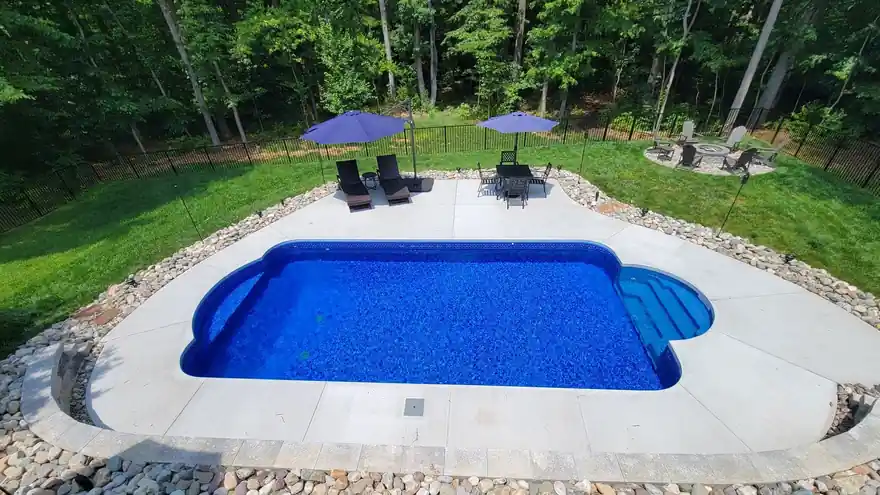
Most pool conversations start with a shape or a feature. Somebody wants a waterfall, or a long rectangle for laps, or a spot for the grandkids to cannonball. Those are good things to want. They're just not the first thing to settle. The first question is plainer: does your yard have room for a pool, and where on the lot does it go?
The answer depends on a handful of facts about your property. Most of them are on paper or underground, and none of them are visible from the back deck. Here's how we work through them with homeowners in Harford, Baltimore and Cecil counties and across the line in southeast Pennsylvania.
Start with the plot plan
When you bought your house, you should have received a plot plan along with the rest of your property paperwork. It's a scaled drawing of your lot that shows the property lines, the footprint of the house, and the setbacks that come with the property. It's the single most useful document for a first conversation about a pool.
If you can't put your hands on it, check your closing folder or ask the title company that handled the sale. Once you have it, a pool contractor can mark up the open area and see quickly how much room the yard really has.
Property lines and setbacks
A setback is the distance a structure has to stay back from a property line. An easement is a strip of your land that someone else, often a utility, has a right to use. Between them, a yard that looks wide open can have a much smaller buildable area than you'd guess.
We can't tell you from a distance what your particular lot allows, and we won't pretend to. What we can do is read the plot plan with you and point out where the questions are. Then we get the real answer from the people who set the rules, which comes up again below.
Your well and septic system
Plenty of homes in northern Maryland and southeast Pennsylvania run on a private well and a septic system instead of public water and sewer. If yours does, you need to know exactly where the well, the tank and the drain field sit. Those take up ground you can't casually dig into, and a pool has to be placed with them in mind.
This is the item that surprises people most. The roomy side yard that seemed perfect turns out to be sitting over the drain field. It's far better to learn that on day one, with a pencil, than after someone has marked out a pool with spray paint.
Slope, grade and retaining walls
A level lot is the easy case. Many yards in this part of the country roll, drop toward a tree line, or sit above the street. Elevation changes how a pool is dug, where the water line sits relative to the patio, and whether you'll need a retaining wall to hold back the soil on the uphill side.
A retaining wall isn't a dealbreaker. It's a line item, and it can also become part of the look, with stone or block that ties into the patio. What matters is knowing about it during design, when you can plan around it, rather than discovering it with an excavator already on site.
If your yard is small or steep, an above ground pool is worth a look. It generally only calls for some grading to make sure it sits level, and it doesn't need the major excavation an in-ground pool does.
What else shapes the layout
- How much of the yard you want to give up to the pool versus patio, lawn and play space
- Which door of the house will be the main way out to the water
- Which view you want, from the kitchen window, the porch or the deck
- Whether the pool is mostly for the family, or for the big party with a crowd around it
- A traditional shape such as a straight wall with a roman end, or a freeform curve
- Depth and size, and whether you want laps, play, or just a place to cool off
None of these are afterthoughts. They decide where the pool goes just as much as the property lines do, which is why we ask about all of them before we sketch anything.
Let your municipality give the final answer
Rules about pools vary from one municipality to the next. The most reliable way to learn what applies to your address is to ask the office that handles it. That call is simple for someone who makes it often and a bit of a maze for someone who doesn't.
It's part of the service here. Admiral Pools is happy to call your municipality on your behalf, so you get a clear answer without playing phone tag. Then the design can start from what's actually possible on your lot.
If you're wondering whether a pool belongs in your yard, bring your plot plan and your questions to Admiral Pools at 4305 Pulaski Hwy in Abingdon, or call (667) 364-8868. We'll walk through the lot with you, tell you plainly what we see, and give you a free quote on what makes sense.
Admiral Pools LLC, (667) 364-8868
Call (667) 364-8868More articles
Concrete, Vinyl or Fiberglass Pool? How to Choose a Shell
Each type of pool shell has a personality, and the best one depends on your yard, your plans and how long you'll stay.
Pool Lighting After Dark: What to Plan and What to Ask For
Good lighting turns a pool from something you use at noon into a place you want to be at nine.